


News

Greetings, colleagues and friends. I am Xia Bang'en. On behalf of the TCM Liver Disease and Oncology Branch of the Zhejiang Provincial Association for Folk Traditional Chinese Medicine Research and Development, I wish you all a Happy New Year in 2026, good health, and success in everything.
Case Sharing
Preface
Traditional Chinese Medicine (TCM) is a clinical methodology guided by the concept of holism, based on the physiology and pathology of Zang-fu organs and meridians, and characterized by syndrome differentiation and treatment. In treatment, rather than fixating on a single or partial symptom, it is crucial to clearly identify the cause, disease, symptoms, and syndrome. Through data collected via the Four Diagnostic Methods, precise syndrome differentiation must be achieved. Any error in these steps can lead to a world of difference in overall therapeutic outcomes. Today, we will briefly discuss the precautions for TCM syndrome differentiation, medication usage, and treatment plans for decompensated liver cirrhosis through a specific case study.
I. Background and Course of Events
On the morning of November 25, 2025, I received a call from Mr. Zhou Guohui, Vice Chairman of the 12th Zhejiang Provincial Committee of the Chinese People's Political Consultative Conference. He mentioned that a friend of his from Jiaxing was suffering from severe liver disease and had not improved despite seeking treatment in many places; he asked if I could examine the patient. I replied that as a specialist in TCM liver diseases, I was confident the patient would recover quickly after treatment. The next day, Mr. Song from Jiaxing arrived in Fenghua via high-speed rail. He reported a multi-year history of liver cirrhosis. Over the years, he had visited major hospitals and renowned doctors, but his condition had progressively worsened. He had developed ascites and splenomegaly, and his platelet count was only 30,000/μL. He spent thousands of yuan monthly on imported platelet-boosting injections, which barely maintained his levels without any real improvement. Last month, he consulted a highly famous TCM expert and took Chinese herbal medicine for 24 days.
However, his condition deteriorated further after taking the medication. Abdominal distension worsened, persistent pain occurred in the liver area, and notably, his prothrombin time skyrocketed from 13.8 seconds before taking the herbs to 24.6 seconds (as shown in the figure).
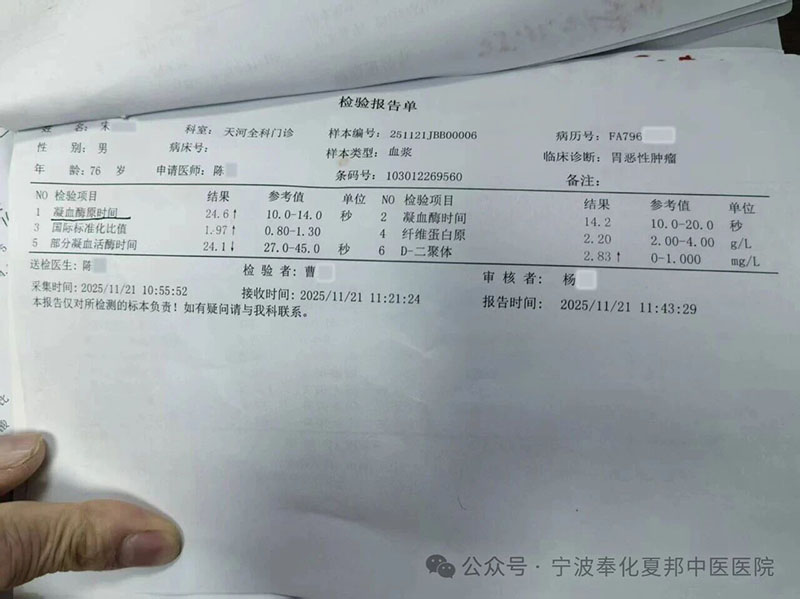
(△ Laboratory Report Dated November 21, 2025)
This indicated that the patient's liver function was collapsing rapidly, the risk of massive hemorrhage had escalated sharply, and he was in a state of liver failure. After understanding the changes in the patient's condition, I reviewed the prescription written by that expert (see figure below).
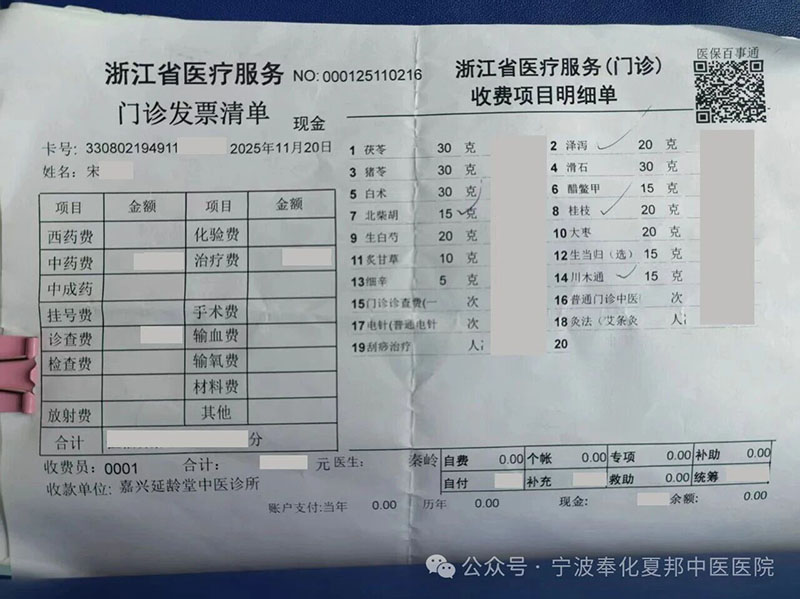
(△ Prescription Image)
Drawing on my years of experience in treating liver diseases, I identified the problem. The prescription used 15g of Bupleurum (Chai Hu) and 20g of Cinnamon Twig (Gui Zhi). This violated a basic principle in TCM: misled by the false manifestations of abdominal pain and aversion to cold, the doctor only saw Yang deficiency and Liver Qi stagnation. Consequently, he simultaneously used Bupleurum, which can deplete Liver Yin, and Cinnamon Twig, which is warm and damages Yin, causing the condition to deteriorate acutely. The patient's abdominal pain and aversion to cold were not simply due to insufficient Yang energy but were manifestations of Yin damage affecting Yang—a pseudo-Yang deficiency within a mechanism of internal heat and Yin deficiency. Using relatively large doses of Bupleurum and Cinnamon Twig for 24 days further impaired the metabolism of an already Yin-deficient decompensated liver, leading to increasingly severe abdominal distension and pain. Having identified the errors in the previous TCM treatment, I prescribed 10 doses of herbal medicine. My formula also included Bupleurum and Cinnamon Twig, but at much lower dosages. It was combined with herbs that soften the Liver, preserve Yin, prevent bleeding, strengthen the Spleen, boost Qi, and address Yang damage (see prescription image). I instructed him to follow a vegetarian diet as much as possible. Mr. Song was puzzled because almost every expert over the years had told him to enhance nutrition, and he had followed medical advice to consume high-quality animal protein long-term, yet his condition never improved. I explained that he had been misled by incorrect advice from those experts and promised him that his condition would undoubtedly improve within 10 days of taking my medicine.
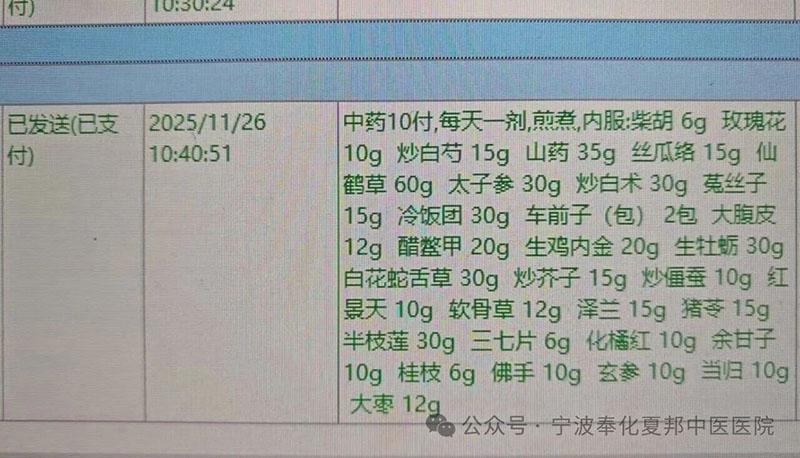
(△ Dr. Xia’s Prescription Image)
Indeed, just three days after returning to Jiaxing, the patient called back, reporting significant relief from abdominal distension and pain! I advised him to recheck his blood markers after completing the 10-day course. The results were astonishing! His prothrombin time had returned to 13.6 seconds, abdominal distension had disappeared, and pain was completely relieved. Such a severe condition was fully reversed within 10 days! I then prescribed another 14 days of herbal medicine and reminded him to continue resting and maintaining his diet. Late last month, the patient returned to our hospital for a follow-up. His prothrombin time was 11.6 seconds (see figure), which is entirely normal. There was also an unexpected surprise: his platelet count, previously stuck at around 30,000/μL, had risen to 73,000/μL. An indicator that thousands of yuan worth of monthly imported injections failed to improve had increased significantly after just 24 days of TCM treatment! Furthermore, ultrasound showed a substantial reduction in ascites and noticeable shrinkage of the spleen.
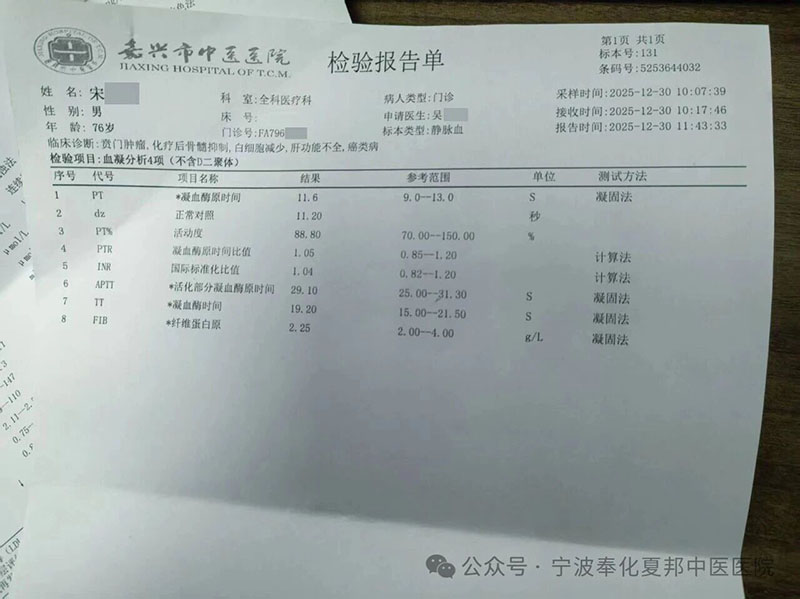
(△ Laboratory Report Dated December 30, 2025)
Mr. Song, having gone through this frightening ordeal, asked me why the same type of Chinese medicine could reverse such a severe condition so rapidly. I shared my answer with him and now share it with you all.
II. Case Precautions and Experience Sharing
First, patients with end-stage liver disease often present with insufficient Yin and excess Yang. Accurate syndrome differentiation is paramount. Even if a patient exhibits symptoms of aversion to cold, do not focus solely on superficial manifestations; formulate prescriptions with extreme caution!
Second, regarding herbal medication: since ancient times, Bupleurum has been known to potentially deplete Liver Yin. Patients with liver cirrhosis should not use it in large doses; moderate amounts, however, have the effect of softening the Liver. Cinnamon Twig is warm in nature, and heavy use will inevitably damage Yin; dosage must be carefully controlled. Of course, these insights are derived from my clinical experience, and I welcome discussion and corrections from fellow practitioners.
Finally, based on my long-term accumulation of experience in treating liver diseases, patients with advanced liver cirrhosis should adhere to a primarily vegetarian diet. Consuming large amounts of so-called high-quality animal protein is inadvisable, as it forces decompensated hepatocytes into a state of chronic overload, causing the disease to linger and worsen. As the saying goes, "The Liver prefers clearing to tonifying"—this perfectly encapsulates the principle. The expert Mr. Song consulted committed errors in all three of these aspects, resulting in severe deterioration after 24 days of TCM treatment.
III. Conclusion
Chinese herbal medicines indeed generally have low toxicity, and there were no toxic ingredients in that expert's prescription. However, as TCM practitioners, we must be extremely cautious and meticulous in syndrome differentiation during diagnosis and treatment. We must never overlook the properties, flavors, and Yin-Yang biases of herbal medicines. Especially when dealing with complex and difficult diseases, we must dedicate ourselves wholeheartedly, peel back the layers like unwinding silk, and strive for excellence. This article briefly outlines my personal views for mutual encouragement with you all.
Note: This is the first article published following the establishment of the TCM Liver Disease and Oncology Branch of the Zhejiang Provincial Association for Folk Traditional Chinese Medicine Research and Development. It is intended solely for sharing experiences and facilitating discussion. Colleagues and friends are encouraged to leave comments, exchange ideas, and offer corrections after reading.
Author: Feng Shibo
Honors of the Xiabang Medical Team
① Director of the TCM Liver Disease and Oncology Branch of the Zhejiang Provincial Association for Folk Traditional Chinese Medicine Research and Development; Deputy Director of the Folk Characteristic Diagnosis and Treatment Technology Branch of the Zhejiang Society of Traditional Chinese Medicine.
② The Major TCM Research Project of Zhejiang Province, "Study on the Efficacy and Mechanism of Smilax Glabra Compound in Liver Failure," achieved significant clinical breakthroughs and passed acceptance verification, reducing the 24-week mortality rate of acute-on-chronic liver failure to 19.2%.
③ Research on innovative TCM drugs for the treatment of acute (subacute) liver failure has been included in the Vanguard Plan for Major Technological Breakthroughs of the Zhejiang Provincial Department of Science and Technology.
④ A clinical protocol for TCM-dominant treatment of malignant lymphoma has been incorporated into the Clinical Research Plan of Zhejiang Provincial Administration of Traditional Chinese Medicine.
⑤ Collaborated with the Academy of TCM Sciences at Zhejiang Chinese Medical University to jointly establish the Research Center for TCM Diagnosis and Treatment of Difficult Diseases.
⑥ With strong support from a group of top domestic scientists in the field of TCM, the Ningbo Xiabang TCM Industry Development Guidance Committee was established.
Please like, follow, share, and leave comments. Every fascinating story comes from real-life events. The next issue will be even more exciting—stay tuned!

 浙公网安备 33028302000750号


