


News

Case Sharing
Preface
Patient: Mr. Mei | Male | 67 years old | Mantle Cell Lymphoma
Initial Consultation: October 5, 2025 | Follow-up Cutoff: February 26, 2026
Background and Course of Events
Despair: Pronounced "Unlikely to Survive 10 Days," Family Plunged into Hopelessness
Mr. Mei, aged 67, was diagnosed with mantle cell lymphoma, an aggressive form of mature B-cell non-Hodgkin lymphoma. Following his diagnosis (see Figure 1), he underwent three rounds of chemotherapy at a local tertiary hospital. However, his physical condition deteriorated rapidly: he experienced severe hair loss, extreme weakness, tumor invasion of the bone marrow, bilateral leg edema, and an inability to walk independently. He also developed severe pericardial effusion and pleural effusion, accompanied by extreme chest tightness and difficulty eating. Specialists assessed his condition as critical and terminal, concluding he would likely not survive more than 10 days and advising the family to prepare for his passing. In resignation, his family had already purchased a burial plot and an urn.
From the onset of the illness, the family faced a dilemma. One family member, a licensed Western medicine physician, strongly opposed Traditional Chinese Medicine (TCM), fearing that herbal remedies would delay proper treatment and worsen the condition, remarking, "If this disease could be cured by herbs, then that TCM doctor must be immortal!" Conversely, the patient's brother-in-law, a folk TCM practitioner, could not bear to watch his relative deteriorate further. Insisting on trying everything possible as a last resort, he advocated for TCM. After a heated family debate over "to treat or not to treat, Western medicine vs. TCM," the family ultimately held onto a glimmer of hope. While the patient lay in his hospital bed awaiting death, they sought out Dr. Xia Bang'en.
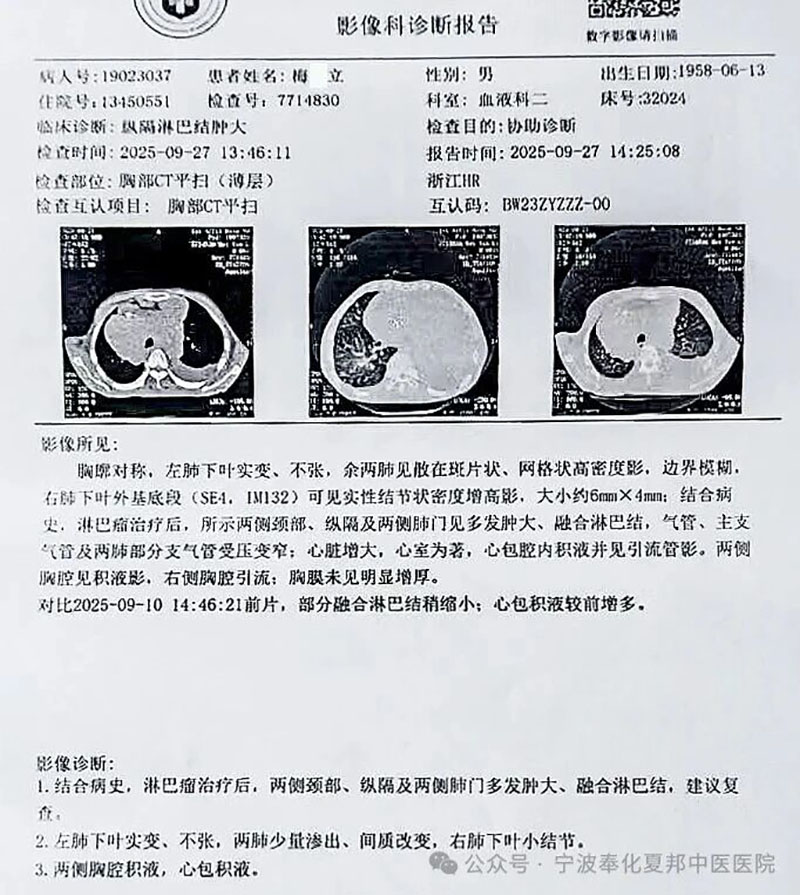
(△ Imaging Diagnostic Report Dated September 27, 2025)
Initial Consultation: Hanging by a Thread, Video Diagnosis
On October 5, 2025, as the patient was bedridden and critically ill, Dr. Xia conducted a video consultation and prescribed five days of herbal medicine. As the decoction was administered spoonful by spoonful, Mr. Mei’s condition surprisingly improved with each passing day. By October 10, after being discharged against medical advice, Mr. Mei was supported by his family; although walking remained difficult and his spirit low, he had resumed relatively normal eating. After detailed syndrome differentiation, Dr. Xia determined that the patient suffered from severe deficiency of vital Qi, internal invasion of cancer toxins, and obstruction by phlegm-dampness and blood stasis. The core treatment strategy was: first support vital Qi, reduce toxicity while enhancing efficacy, promote diuresis to reduce swelling, and resolve phlegm to dissipate nodules. Rather than blindly attacking the cancer, the priority was to ensure the patient could "survive and live comfortably" before gradually bringing the tumor under control.
Turning Point: A Miracle of Life Within 10 Days
On October 21, 2025, Mr. Mei returned for a follow-up. He was eating normally, his physical state recovering rapidly, and symptoms of chest tightness, shortness of breath, and dyspnea had significantly improved—remarkably, he walked into Dr. Xia’s clinic unassisted. From October 2025 to February 2026, after just four months of pure TCM treatment, Mr. Mei underwent astonishing changes: pericardial effusion decreased significantly, pleural effusion was absorbed, breathing became smooth, and sleep returned to normal. Tumor masses shrank, and lesions were completely controlled (see Figure 2). He is now fully capable of self-care.
Transitioning from "abandoning treatment" to "rebirth," Mr. Mei and his family have repeatedly expressed their gratitude to Dr. Xia Bang'en: "Traditional Chinese Medicine gave us a second life!"
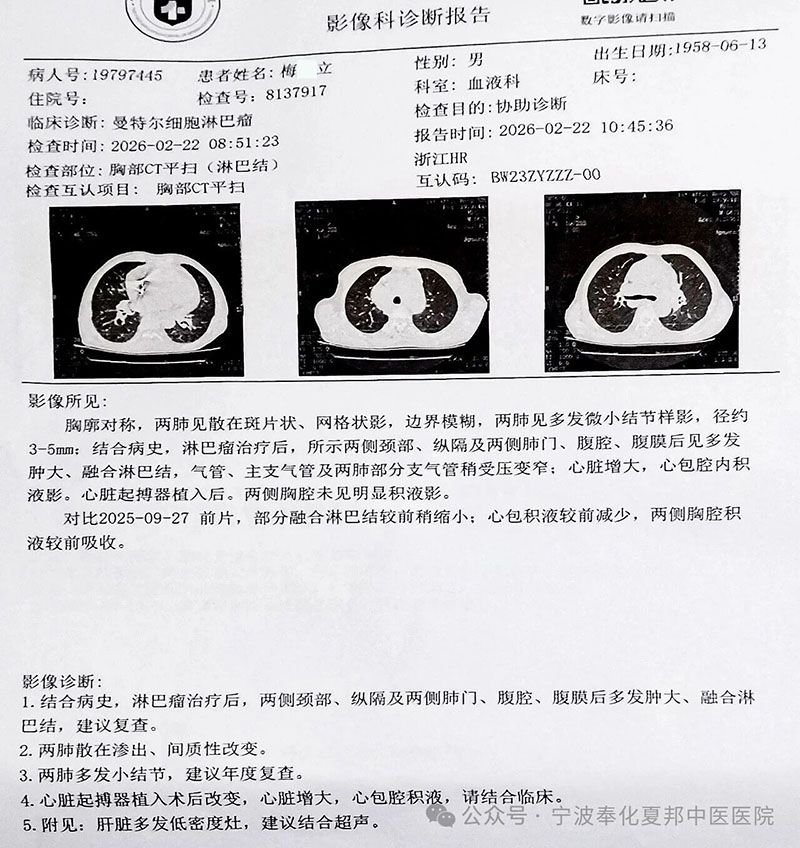
(△ Imaging Diagnostic Report Dated February 22, 2026)
Case Precautions and Experience Sharing
Dr. Xia notes that mantle cell lymphoma is merely one subtype of malignant lymphoma. Modern medicine primarily relies on chemotherapy and targeted therapy; however, elderly patients, those in advanced stages, or those with weak constitutions who cannot tolerate chemotherapy are highly susceptible to accelerated decline due to treatment side effects. Integrating TCM in oncology is not contradictory to conventional care; it can mitigate the toxic side effects of radiotherapy and chemotherapy, boost immunity, protect organ function, shrink tumors, prolong survival, and improve quality of life. Dr. Xia emphasizes: advanced-stage cancer does not equal a dead end. With precise syndrome differentiation and appropriate medication, clinical approaches for two major malignancies—malignant lymphoma and squamous cell carcinoma—are relatively mature. Even when using TCM as a standalone treatment, it can ignite hope for many patients in desperate situations.
Author: Zhou Zhibin
Honors of the Xiabang Medical Team
① Director of the TCM Liver Disease and Oncology Branch of the Zhejiang Provincial Association for Folk Traditional Chinese Medicine Research and Development; Deputy Director of the Folk Characteristic Diagnosis and Treatment Technology Branch of the Zhejiang Society of Traditional Chinese Medicine.
② The Major TCM Research Project of Zhejiang Province, "Study on the Efficacy and Mechanism of Smilax Glabra Compound in Liver Failure," achieved significant clinical breakthroughs and passed acceptance verification, reducing the 24-week mortality rate of acute-on-chronic liver failure to 19.2%.
③ Research on innovative TCM drugs for the treatment of acute (subacute) liver failure has been included in the Vanguard Plan for Major Technological Breakthroughs of the Zhejiang Provincial Department of Science and Technology.
④ A clinical protocol for TCM-dominant treatment of malignant lymphoma has been incorporated into the Clinical Research Plan of Zhejiang Provincial Administration of Traditional Chinese Medicine.
⑤ Collaborated with the Academy of TCM Sciences at Zhejiang Chinese Medical University to jointly establish the Research Center for TCM Diagnosis and Treatment of Difficult Diseases.
⑥ With strong support from a group of top domestic scientists in the field of TCM, the Ningbo Xiabang TCM Industry Development Guidance Committee was established.
Kind Reminder: This article presents a real clinical case and is intended solely for medical education and reference purposes; it does not constitute diagnostic or therapeutic advice.
If you have similar conditions, please visit a hospital for an in-person consultation and individualized syndrome-based treatment.

 浙公网安备 33028302000750号


